
SuperScrimping – Reducing Your Grocery Budget Plus Simple Spaghetti Bolognese

Channel 4 are showing a great series at the moment called SuperScrimpers.

I’m loving that being frugal is now considered ‘on trend’! Yay! Finally!

As one of those that has been part of this growing community for 3 years plus, it’s refreshing.  What it does mean, however, that as an experienced SuperScrimper the show can’t teach me much I don’t already know.  Disclaimer ;-) – I don’t scrimp in all areas of my life. I don’t mind spending money but I hate wasting money! It’s about spending on what really is significant to you, not frittering it away here and there, but rather practicing Conscious Spending.

Those who have been following this blog for some time will know that in September 2011 I decided to reduce my grocery budget by 50% through choice.

I think now might be a good time for an update, and to share a healthy and nutritious recipe that would make any SuperScrimper proud.

Continue reading

How I Meal Plan On A Reduced Grocery Budget

Since reducing our grocery spend by 50% meal planning has become even more critical.

Also important is keeping an eye on stocks in the cupboard and freezer. Not only am I spending less (considerably less) on food, our food waste is almost non-existent.

I thought I’d share how I did it this week.

Continue reading

Sticking To A Reduced Grocery Budget When The Honeymoon Period Is Over

It’s relatively easy to do anything once.

Doing something day in day out, week after week, takes a little more effort.

That’s what forming habits are all about. A habit is something you don’t have to think about, you just do it.

I’m probably not quite there yet with making the reduced grocery spend a habit – not yet anyway. Hitting a target of £50 each week is still a challenge.

How do I meet that challenge now the honeymoon period is over?

Continue reading

How To Reduce Your Weekly Grocery Spend By 50%

At the end of June this year I conducted a Cooking From Scratch Experiment. I learnt a lot from doing it. Most of what I learnt came from you dear readers and your feedback. It made me think about how I was grocery shopping and preparing my meals, including the ingredients I was using and what I was purchasing.

The experiment concluded that by ‘Cooking From Scratch’ you can save in excess of 40% on ready-made foods, for me personally this could mean an extra £1500 plus each year (post tax) in the bank. My conclusions I have posted over at Ex-Consumer this week in the post Buying Ready-Made Foods Versus Cooking From Scratch.

I may not make any money from my blogging endeavours, but I certainly save money! Reading and writing about minimalism and leading a simple life keeps my

‘Head In The Game’.

Today I’d like to share how since conducting the experiment I have managed to reduce my weekly grocery spend by 50%. Chez Wright’s Grocery Budget was £100 a week, for the last few weeks I have managed to spend just £50.

This is how you could do it too:

  1. Challenge yourself to stick to a new reduced budget! In my case I decided to ‘go for it’ and halved my budget. I didn’t know if it was doable, it was. Reader feedback from my experiment made me question whether I was spending ‘up’ to a budget. So I decided to spend ‘down’. I had £50 and that was it, I had to choose wisely.
  2. Meal plan, meal plan, meal plan!!! I cannot emphasise this enough. Whatever your budget, you need a plan. Haphazard grocery shopping leads not only to wasted money but wasted food. If in doubt check out The Simple Guide To Meal Planning.
  3. Look at alternative ways of doing your shop to reduce cost! I have always been a fan of online grocery shopping. It’s highly convenient, it’s reduces browsing and impulse purchases and makes it very easy to stick to your list based on your meal plan. However it became apparent I was becoming complacent. For a while I’d been shopping for a few things in the high street as prices were considerably cheaper at my favourite shop Home Bargains. I started noticing that many staple items were up to 50% cheaper than I was paying online. I now use 2 hours of my time each week to physically shop. I write 4 shopping lists. One list for Home Bargains and staple items, one for the freezer shop (milk, ice-cream etc), one for the outdoor market where I buy fresh produce and one for the butchers. I’m lucky that all these are all in the same vicinity.
  4. Carry your shopping! I do drive to do my shop, and I park on a car-park. I then have to carry at least two separate loads back to the car. By carrying your shopping I guarantee you will think twice about popping that impulse purchase in your trolley! Last week I do not know how I got back from the market and butchers to the car, my arms were dropping off… and think of the calories I burnt.
  5. Reduce the amount of meat you eat! Not everyone is cut out to be vegetarian. If you can follow a non-meat diet you can indeed reduce your spend, and of course there are many other reasons for doing it, but it is deeply personal thing for everyone. I’ve never been a big meat-eater, and ensure that what meat the family do consume that it is of high quality. A simple way to reduce spend is to cut back on meat products or put less meat in your dishes. Our Sunday Roast now consists of Toad in the Hole which uses approx. 6 high quality sausages rather than a joint of meat. This is about a 60% cost saving.
  6. Think alternatives! As with switching a meat joint for sausages, think of alternatives to reduce cost. This could mean switching brands, for example I now pay 79p for 36 Breakfast Wheat Biscuits instead of over £2 for the leading brand. We haven’t compromised, the quality is comparable and they taste great. You could also compromise on the type of product. I always purchased freshly squeezed Orange Juice, and it was costing up to £5 a week. By reducing the quantity and type of OJ I buy it now costs less than £2.
  7. When it’s gone it’s gone! By Thursday now we are out of OJ most weeks. Too bad. We now wait till the next weekly grocery shop is done, no nipping out and restocking. Every time you enter a shop you will spend more money than you anticipate unless you are very disciplined. Not having an infinite supply of something makes you value it more. If the Hubby want’s the OJ to last 7 days, he needs to put a little less in his glass each morning. Aren’t I cruel? Don’t worry I’m hard on myself also, the coffee was rationed this week as I could see it was diminishing. So I drank a cup less a day – no bad thing eh?This post over at Zen Habits is worth a read.
  8. Reduce Luxuries! Certain things enter our grocery shop as luxuries, get cosy and end up being a staple item. I’ll admit that pre-summer we were easily buying and consuming 3 bottles of wine at an approx. cost of £15 a week. I had a budget of £100 and very often would find once I’d spent £80 I was done and would then wine shop. This has stopped. There is no need for us to have wine each night with dinner, particularly as I am training for a half marathon and alcohol dehydrates the body (I’m dehydrated enough!). It had become a habit. I now buy one bottle a week.
  9. Stretch what you do have! If making a spaghetti bolognese add extra tomatoes or mushrooms rather than mince to increase servings. When making Chilli use extra beans such as kidney and haricot to reduce meat content or eliminate meat altogether from the dish as I have now done. Pour a little less custard over a piece of apple pie so it goes round further, drink a little less OJ or wine, or coffee. Just a fraction less of each will make a big difference overall.
  10. Cook more from scratch! We have come back to where this post began. I’m in no doubt that by using basic ingredients rather than ready-made products that you can save money. My spaghetti bolognese sauce consists of toms, garlic,onion, stock cube, black pepper, herbs and puree, it’s cheap and I have it on good authority it’s as tasty as anything that comes out of a jar.
What could you be doing to reduce your grocery spend? Could any of the above help you to save a little more?
————————————————————————————————–

The Simple Guide to Meal Planning

This post was originally written as a Guest Post over at The Minimalist Mom
I am a huge advocate of meal planning, and here I outline the basics – enjoy!

The Simple Guide to Meal Planning by simplybeingmum

Meal Planning can seem a daunting task, and yet by following this simple guide, I guarantee you will save time, money and effort, and ultimately reduce waste.

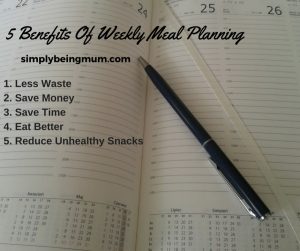
By Meal Planning you will:

  1. Save Time – No more wandering round the store with no direction, or wondering what to cook for dinner that night. No emergency trips to the store for ingredients you don’t have, or ad hoc dinners out due to lack of supplies.
  2. Save Money – By only buying what you plan to eat and resisting impulse purchases, you will save money. There is no doubt.  You also reduce costs by not throwing away unused foodstuffs.
  3. Save Effort – Being disorganised requires more effort than being organised (in the long-run), you know what you are eating and when, you can prep in advance and it requires less decision-making on a daily basis.
  4. Reduce Waste – It is estimated that in the UK 8.3m tonnes of food each year gets thrown away by households. This equates to almost £700 a year of food waste for an average family. By reducing this waste in real terms the CO2 impact would be the equivalent of taking 1 in 4 cars the road. (* source www.lovefoodhatewaste.com)

Six Simple Steps to Meal Planning

  1. The first step has nothing to do with food. Set aside 30 minutes with the family to establish everyone’s diary for the forthcoming week. I do this on a Thursday evening. I know who needs lunches and dinners and whether we are eating out at all.
  2. Write out a daily meal plan based on everyone’s diary, I plan Saturday-Saturday as I receive my groceries Saturday morning. Breakfast, Lunch, Dinner and Snacks are planned for. The first couple of times you do this it may be time-consuming, but as you start to replicate meals it gets easier. To reduce time and effort further you could draw up a monthly menu, and rotate 4 weeks worth of meals.
  3. Throughout the week note down anything that needs replenishing as you use it up.  This will be add-on items, such as herbs, oils and household items.
  4. Only plan for 6 days worth of meals! Seriously this works. Regardless of how good a planner you are, things happen, and you may need to use food up the day before your new batch of groceries. This also gives you an opportunity to get you culinary creative thinking cap on. If you do clear all food ‘treat’ yourself to a take away or a dinner out – you deserve it!
  5. Before you do your meal plan/grocery shop for the next week (online or otherwise) empty your food/perishables cupboard and do an inventory. Get into a routine. Strip it down and clean it, look to use things up or freeze, note down what you already have and base a meal around those items if they will still be edible. As you only keep a week’s worth of food in at any one time, waste should reduce, you will need less storage and cleaning will be simpler.
  6. Never shop without a list (based on your planned meals) or when you are hungry. I do my grocery shop online, as this eradicates any impulse purchases and also means I do not have to step foot physically in a supermarket (I’d rather be doing something else). If you don’t shop online, the principle is the same, do not deviate from the list regardless of what is on offer, or what new delights they have in store. Do not go into the clothing, toy, magazine section unless you want to add approx.20% to your food bill.
(Today’s post was inspired by Rachel tweeting she had placed her first UK online shop after the big move)